
Manufacturing Quote Comparison: Cut Procurement Costs 15-25%
Compare vendor RFQs in 3 minutes vs 45. AI catches $5K-$15K in annual overcharges. Copper +39%, steel +13% — stop leaving money on the table. Free trial.
Quick Answer: Stop leaving money on the table. Manufacturers using AI quote comparison identify $5,000-$15,000 in annual savings within 90 days — by catching price drift between quotes and invoices, comparing RFQ responses in 3 minutes instead of 45, and negotiating with data instead of gut feel. With copper at record highs (+39% YoY), steel up 13.1%, and 78% of manufacturers citing tariff uncertainty as their top concern (Deloitte 2026), every unverified quote is margin leakage you can't afford.
Definition: Vendor quote comparison in manufacturing is the process of evaluating and contrasting supplier quotations (RFQ responses, invoices, purchase orders) across multiple vendors to identify the best value based on price, terms, quality, and delivery — traditionally done manually in spreadsheets but increasingly automated with AI data extraction tools.
Key Takeaways
"Processed goods for intermediate demand rose 3.4% in 2025, with nonferrous metals surging 4.5% in December alone." — U.S. Bureau of Labor Statistics, PPI Report
"79% of manufacturing executives say the lack of skilled workers is their top barrier to growth." — CADDi 2026 Manufacturing Outlook Study
"Top-performing procurement teams that automate their processes can process purchase orders 76% faster and at 55% lower cost than those using manual methods." — The Hackett Group, via Inverto Procurement Trends 2026
"According to TRO Matcher platform data, manufacturers switching from spreadsheet-based quote comparison identify an average of 22% more pricing discrepancies in their first month — simply because they're now comparing every quote instead of spot-checking."
"Manual invoice processing averages $12-$30 per invoice compared to $1-$5 automated — and 39% of invoices contain errors requiring correction." — APQC 2024 AP Benchmarks
With the ISM Manufacturing PMI contracting for 10 of the last 12 months while input costs keep climbing, small and mid-sized manufacturers face a squeeze from both sides: falling demand and rising material prices. When 78% of manufacturers cite trade uncertainty as their primary concern and 415,000 manufacturing jobs remain unfilled, the margin for procurement errors has disappeared entirely. Here's how manufacturers are using AI-powered quote comparison to protect margins and move faster than manual processes allow.
The Cost of Waiting: With input costs expected to rise 5.4% over the next year and 43% of contractors already reporting projects canceled due to rising costs (AGC 2025), every month without systematic quote comparison costs you money. Manufacturers who delay catching even 2% in price drift on $500K annual material spend lose $10,000+ annually — that's profit walking out the door.
What manufacturers are saying:
"We found $8,400 in supplier overcharges in our first quarter. Our aluminium supplier had been adding a 3% surcharge that wasn't in the original quote — every month for over a year." — James Morrison, Operations Manager, Precision Metal Works, Sheffield
"I was spending every Friday afternoon buried in spreadsheets comparing quotes. Now I upload them as they come in and the comparison is done before my coffee goes cold." — Sarah Chen, Owner, Advanced CNC Solutions, Birmingham
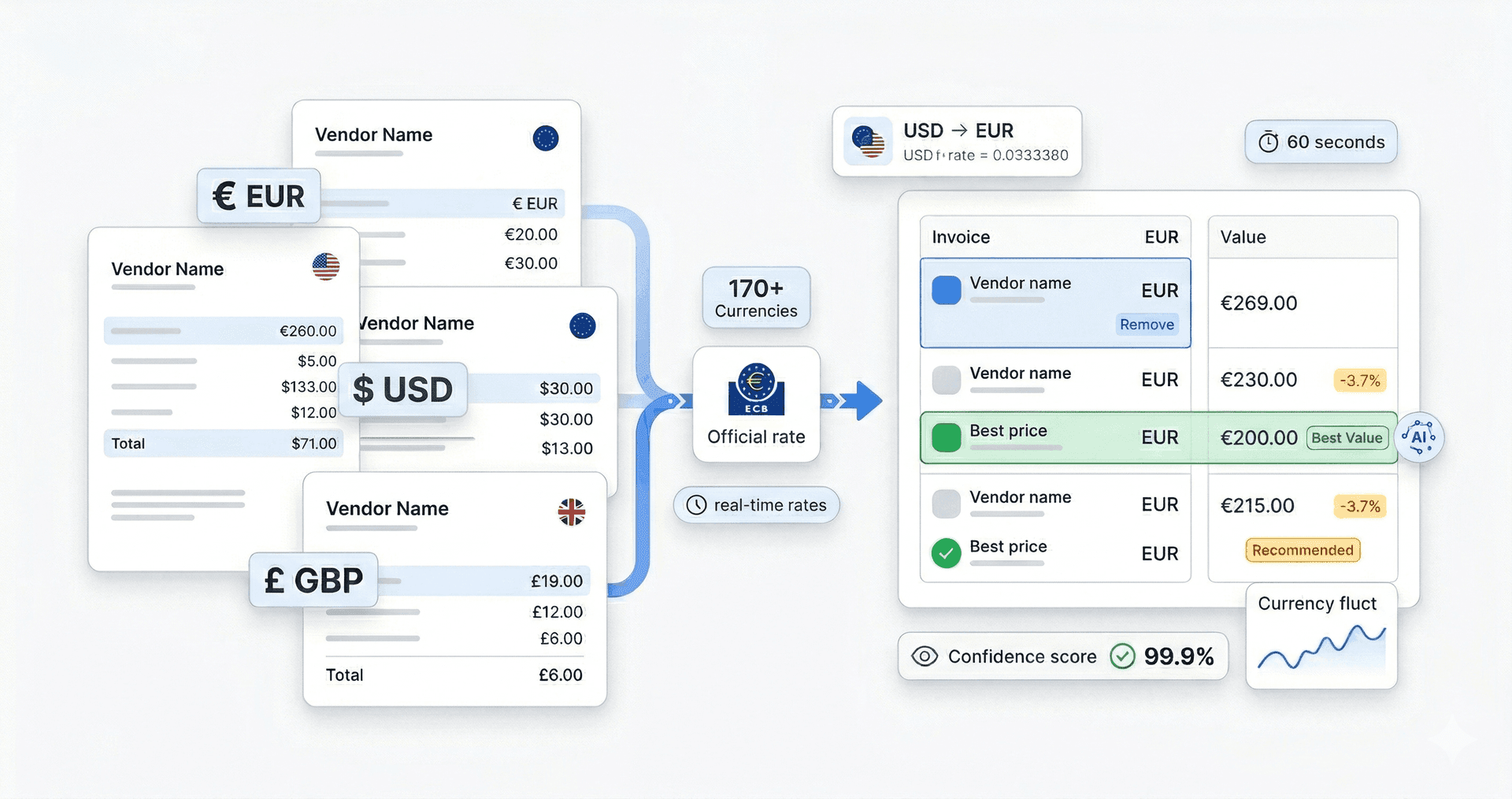
Q: What is the best software for multi-currency invoice processing? A: The best multi-currency software extracts data from invoices in any currency, converts using current exchange rates, and enables apples-to-apples vendor comparison. TRO Matcher supports 170+ currencies with automatic ECB conversion rates.
Contents
- Why are manufacturing procurement costs so volatile in 2026?
- How do manufacturers lose money on vendor quotes?
- How does AI vendor quote comparison work?
- What RFQ strategies deliver the biggest cost savings?
- For Accountants and Bookkeepers Serving Manufacturers
- Your Data, Your Control: GDPR Article 20 Compliance
- TRO Matcher vs. Alternative Solutions
- Case Study: CNC Machine Shop Cuts Material Costs by 17%
- FAQ
Why are manufacturing procurement costs so volatile in 2026?
Manufacturing input costs are rising unevenly across material categories, creating a procurement environment where last month's best-price vendor may be this month's most expensive. The BLS Producer Price Index for processed goods for intermediate demand rose 3.4% in 2025, with nonferrous metals surging 4.5% in December alone (BLS).
But averages mask the extreme swings in specific materials that destroy margin calculations for small manufacturers.
Key material cost changes heading into 2026:
| Material | Price Change | Impact on SMB Manufacturers |
|---|---|---|
| Copper | Record high $13,310/t (+39% YoY) | Electrical components, wiring, connectors |
| Aluminum (Midwest) | All-time high $2.45/lb (+314% premium YoY) | Enclosures, heat sinks, structural parts |
| Steel raw materials | +8% month-over-month (Jan 2026) | Machined parts, fabrication, tooling |
| Nonferrous metals (PPI) | +4.5% in December 2025 | Broad manufacturing input pressure |
Sources: BLS PPI, Steel Market Update, AgMetalMiner
For a 15-person precision machining shop spending $400,000 annually on raw materials, a 39% increase in copper alone can add $30,000-$50,000 to annual costs if copper represents even 20% of material spend. That's the difference between profit and loss for most small manufacturers.
"Trade uncertainty remained the top concern for 78% of manufacturers responding to the NAM Q3 2025 outlook survey, with expectations that input costs will rise by an average of 5.4% over the next year." — Deloitte 2026 Manufacturing Outlook
The tariff compounding effect. Tariff uncertainty isn't just about direct cost increases — it creates vendor pricing instability. When suppliers don't know their own import costs next quarter, they build buffers into quotes. Without systematic comparison, manufacturers pay those buffers without question. The manufacturers who compare every quote against historical pricing and competing vendors catch these built-in margins.
The staffing gap makes it worse. With 415,000 unfilled manufacturing jobs and 79% of executives citing skilled labor as their top challenge, most small manufacturers don't have dedicated procurement staff. The Hackett Group found a 9% procurement efficiency gap in 2025 — workloads growing 10% while budgets rise just 1%. The person comparing vendor quotes is also scheduling production, managing quality, and handling customer orders.
How Do Manufacturers Lose Money on Vendor Quotes? (The 6 Hidden Cost Leaks)
Most procurement cost overruns in manufacturing come from preventable process failures, not market forces alone. Understanding these failure points reveals where the savings hide.
The six procurement cost leaks in manufacturing:
1. Quote-to-invoice price drift — costs $8,000-$12,000 annually
Vendors quote one price during the RFQ process, then invoice a higher amount — sometimes citing material surcharges, freight adjustments, or "updated pricing." Without systematic comparison between the accepted quote and the final invoice, these increases go undetected. A 2-3% drift on $400,000 in annual material spend costs $8,000-$12,000.
2. Format chaos in RFQ responses
Vendor A sends a PDF with lump-sum pricing. Vendor B provides an Excel spreadsheet with line items. Vendor C emails a scanned paper quote. Manual comparison across formats is the "breeding ground for errors that lead to bad decisions," as procurement researchers note. When formats don't match, busy manufacturers default to bottom-line comparison — missing unit price differences, hidden fees, and scope exclusions.
3. Manual data entry errors — $2,400-$4,800 annual cost per employee
The documented 1-4% error rate in manual data entry hits manufacturers particularly hard. APQC research shows manual invoice processing costs $12-$30 per invoice versus $1-$5 automated (APQC 2024), with 39% of invoices containing errors requiring correction. For manufacturers, these errors manifest as wrong quantities ordered, incorrect unit prices approved, and production delays from ordering the wrong specifications.
"About 39% of invoices contain errors. For a mid-sized manufacturer processing 1,000 orders monthly at 90% accuracy, that's 100 potential shipping delays, inventory mismatches, or invoice discrepancies." — Adeptia/Supply & Demand Chain Executive
4. Volume discount blindness
Without visibility into total spending across material categories and projects, manufacturers miss consolidation opportunities. Combining orders across production runs or product lines can unlock 5-15% volume discounts — but only if you can see the total picture. Nearly half of all procurement still happens in spreadsheets, according to Supply Chain Dive, which makes cross-project visibility nearly impossible.
5. Specification mismatch costs
In manufacturing, not all "equivalent" materials are equal. When comparing quotes, differences in material grade, tolerance, surface finish, or certification (ISO, AS9100) can make the cheapest quote the most expensive choice. Manual comparison often catches price differences but misses specification differences that cause quality rejections, rework, or customer returns.
6. Slow cycle times killing competitiveness
The APQC found that top-performing procurement teams complete requisition-to-order in 5 hours, while poor performers take 48 hours — nearly 10x longer. In manufacturing, slow procurement means delayed production starts, missed delivery windows, and lost contracts. When 35-50% of deals go to the vendor who responds first, your procurement speed directly affects your competitiveness.
If you've ever approved a vendor invoice without checking it against the original quote because production was waiting on material, you're not alone — but that's exactly where money disappears.
Suspicious your suppliers are overcharging? Get a Free Invoice Audit — upload your first quote in 60 seconds, no credit card required. See exactly where the money is going.
How does AI vendor quote comparison work? (Save 350+ Hours Annually)
AI-powered vendor quote comparison uses machine learning to extract data from vendor documents — regardless of format — and automatically identify discrepancies, savings opportunities, and specification differences. This technology eliminates the manual bottleneck that costs manufacturers thousands in undetected overcharges annually.
How the quote comparison process works for manufacturers:
-
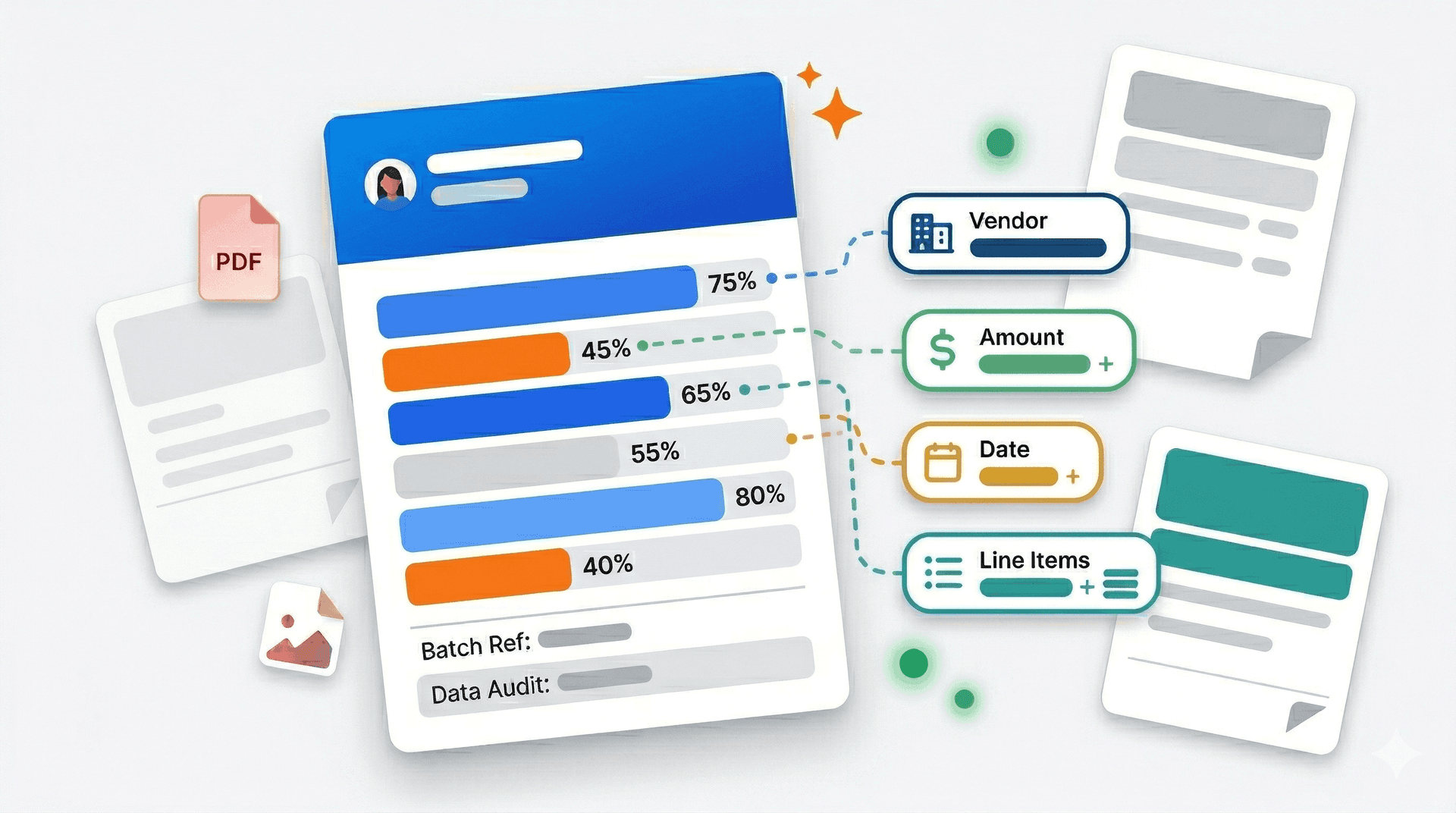
Upload any format: PDF quotes, Excel RFQ responses, scanned paper invoices, or phone photos of packing slips. TRO Matcher accepts 8 formats including HEIC (iPhone), CSV, and XLSX — no retyping required.
-
Automatic data extraction: Invoice data extraction pulls vendor name, part numbers, quantities, unit prices, totals, and terms in under 60 seconds with confidence scores showing extraction certainty on every field.
-
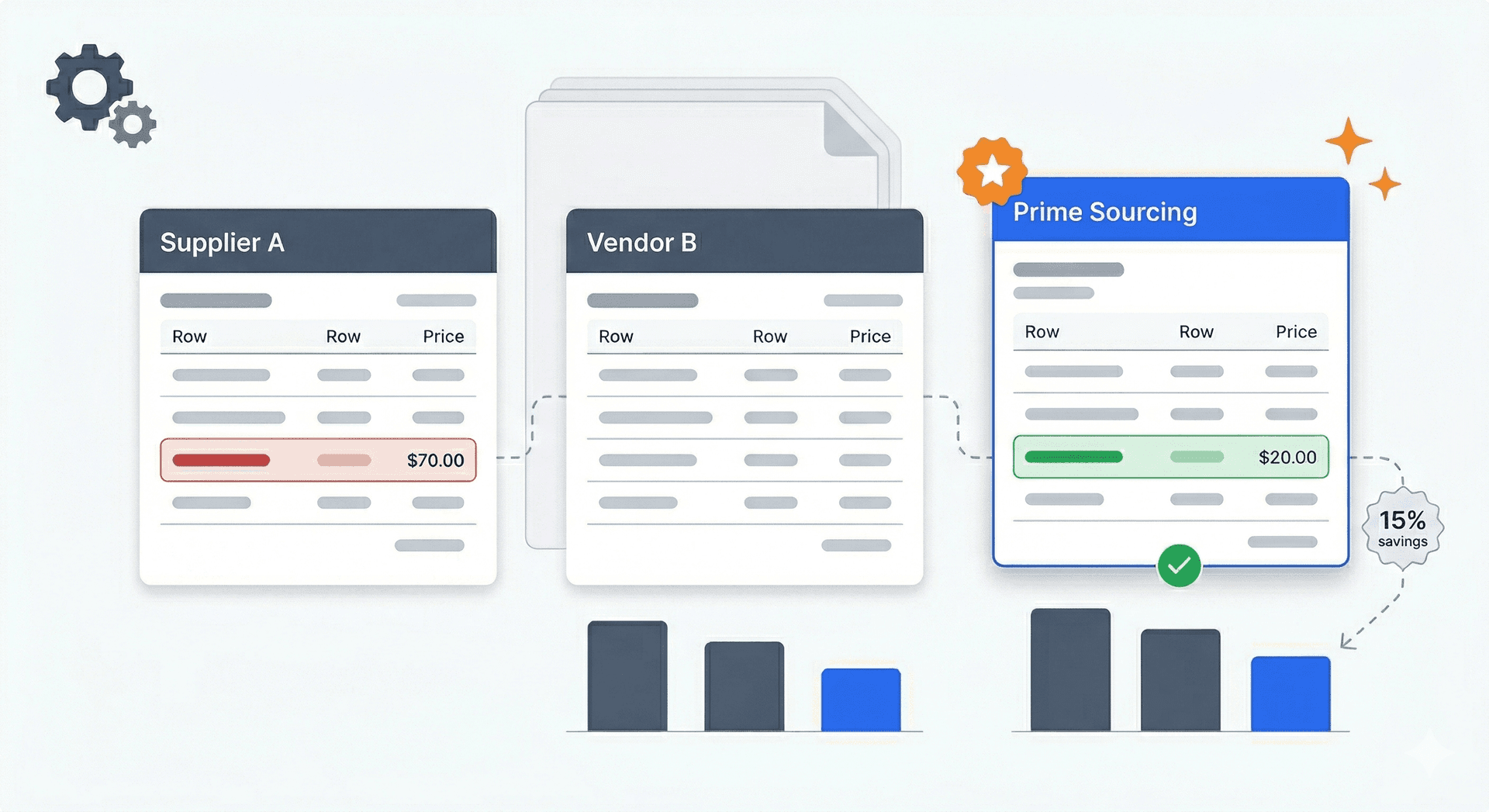
Side-by-side comparison: Compare up to 5 vendor quotes or match invoices against original purchase orders. Price variances are highlighted instantly — no more manually scanning columns of numbers across different document formats.
-
Variance analysis: The system calculates percentage differences, flags unusual pricing, and shows exactly where you're paying more than quoted or where one vendor undercuts another.
-
Export for your systems: Download results as CSV for ERP/accounting import or as PDF reports for procurement review meetings.
Time and accuracy comparison for a typical SMB manufacturer:
| Task | Manual Method | AI Method (TRO Matcher) |
|---|---|---|
| Extract data from vendor quote | 15-20 min | 1-2 min |
| Compare 3-4 RFQ responses | 45-90 min | 3-5 min |
| Match invoice against PO | 10-15 min | 1-2 min |
| Weekly quote review (15 quotes) | 8-12 hours | 45-75 min |
| Error rate | 1-4% (industry benchmark) | ~0% (with human review) |
| Requisition-to-order cycle | 48 hours (poor performers) | Dramatically reduced |
| Annual time saved | — | 350+ hours |
For a manufacturing operations manager billing at $55/hour (or who could be spending that time on production optimization), that's $19,000+ in recovered productive time annually.
"According to TRO Matcher platform data, manufacturers who compare every vendor quote against competing bids and historical pricing catch an average of 3.8 pricing discrepancies per month that would have gone undetected with spreadsheet spot-checking."
Related reading: Invoice Comparison vs Manual Excel: Time & Cost Analysis breaks down the full ROI calculation for small businesses switching from spreadsheets to AI-powered comparison.
Also see: How Construction Companies Save 30% on Material Costs — construction and manufacturing share many procurement challenges, and the strategies for systematic vendor analysis apply directly.
What RFQ Strategies Deliver the Biggest Cost Savings? (15-25% Potential)
The most effective RFQ strategies for small manufacturers combine systematic vendor comparison with data-driven negotiation. Based on industry research, Hackett Group procurement data, and platform analytics, five strategies consistently deliver measurable ROI:
1. Compare every invoice against the original quote
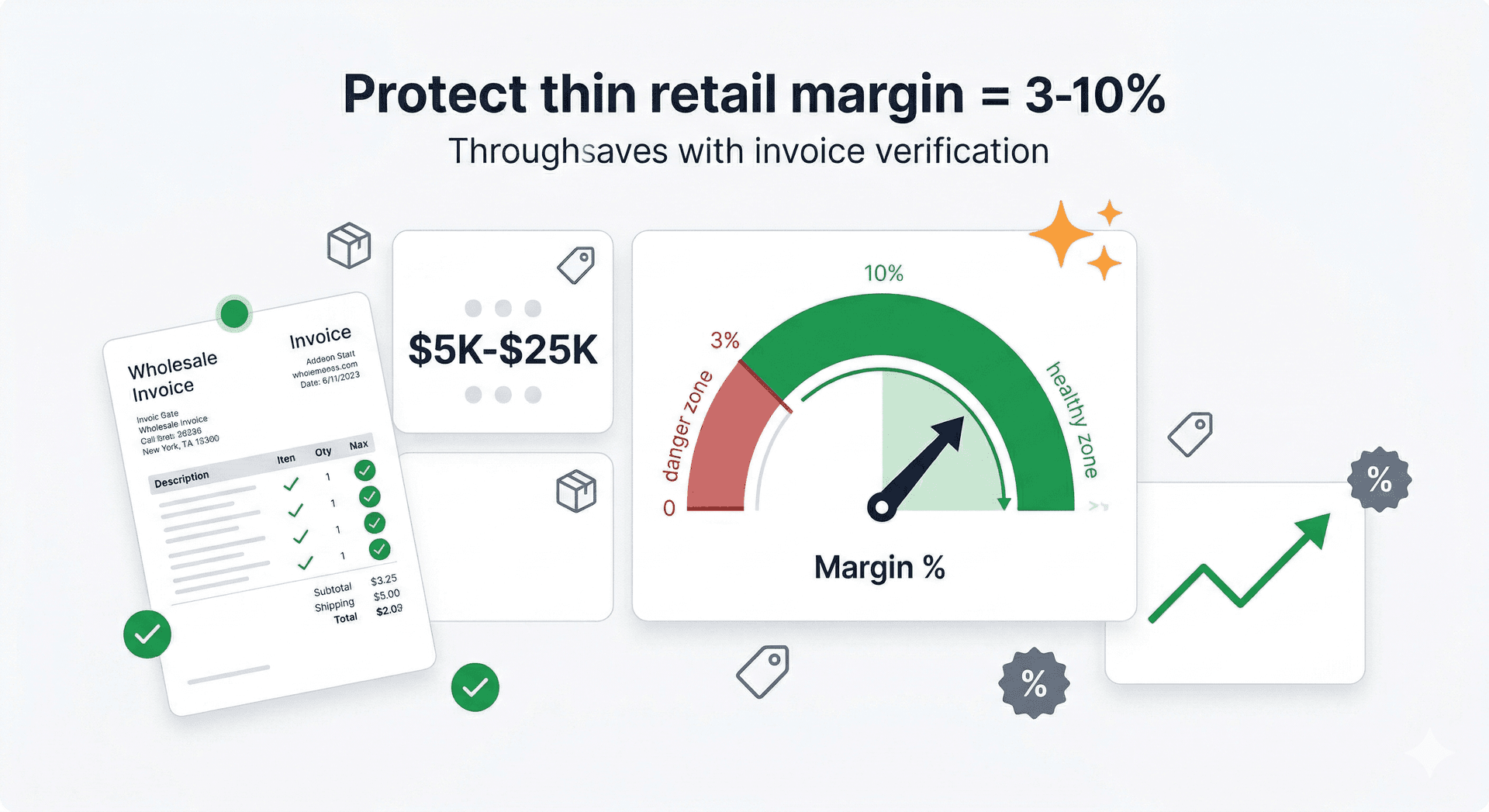
This is the foundation. When every invoice is automatically compared to the accepted quote or PO, price drift becomes impossible to hide. Most small manufacturers only spot-check — AI makes 100% verification realistic without adding staff.
Potential savings: 2-5% recovered from caught discrepancies
2. Maintain a minimum of 3 vendors per material category
Single-sourcing is the most expensive procurement decision a small manufacturer can make. Maintaining at least three qualified vendors per critical material category provides negotiation leverage and supply security. Regular quote comparison keeps vendors honest on pricing.
Potential savings: 5-15% through competitive pressure
3. Consolidate orders across production runs
Combining material orders for multiple jobs or production runs unlocks volume discounts. A manufacturer running 4-5 concurrent jobs can often negotiate 8-15% off by ordering together — but only if you have visibility into total material needs across projects.
Potential savings: 8-15% on consolidated orders
4. Build price history for data-driven negotiations
Export comparison results after each procurement cycle to build documented pricing records. Which vendors are consistently competitive? Which have price creep? When you can show a supplier their pricing trend over 6 months compared to competitors, negotiations shift from adversarial to data-driven.
Potential savings: 5-10% through documented negotiation leverage
5. Automate reorder comparisons for recurring materials
For materials you purchase repeatedly (steel stock, fasteners, consumables), set up recurring comparisons. When the AI flags that your regular supplier's price has risen 5% while a competitor holds steady, you can act immediately instead of discovering it at quarter-end.
Potential savings: 3-7% on recurring material purchases
"Companies with efficient procurement processes report 15-25% cost savings and 40% faster time-to-market compared to those with manual or fragmented approaches." — NetSuite Procurement Research
For Accountants and Bookkeepers Serving Manufacturers
If you manage finances for manufacturing clients, you know the challenge: high material spend, dozens of vendor invoices monthly, volatile material pricing, and clients who are too busy running production to verify every supplier invoice.
How TRO Matcher helps accounting professionals serving manufacturers:
- Fast quote comparison: Upload client vendor quotes and invoices in any format, get side-by-side price variance analysis showing every difference across suppliers and time periods
- Audit-ready documentation: Every comparison is timestamped and exportable — essential for manufacturing clients facing ISO audits, tax reviews, or insurance documentation
- Client-ready exports: Professional PDF reports showing exactly where vendor pricing has deviated from quotes, with dollar impact calculated
- Multi-currency support: Handle international vendors with automatic ECB rate conversion for all major currencies — critical for manufacturers sourcing globally
- CSV exports for accounting software: CSV and PDF exports ready for import into QuickBooks, Xero, and other accounting platforms or ERP systems
The partnership opportunity: Manufacturing owners are desperate for procurement cost visibility but don't have time to build it themselves. When you can show a client you identified $5,000 in vendor overcharges during routine invoice processing, that conversation transforms your relationship from "cost center" to "profit protector."
Accountants who introduce invoice automation to their manufacturing clients become indispensable. The tool does the data extraction; your expertise in interpreting the results and recommending vendor strategy is what clients pay premium rates for.
Your Data, Your Control: GDPR Article 20 Compliance
Unlike enterprise procurement systems that lock your vendor data in proprietary formats with multi-year contracts, TRO Matcher ensures you always own and control your information.
Why data portability matters for manufacturers:
- Audit readiness: Export complete vendor quote history and invoice comparisons for ISO 9001/AS9100 audits, tax authority reviews, or customer quality documentation
- Switching freedom: If you change systems or outgrow the tool, take all your data with you — no vendor lock-in, no migration fees
- Legal protection: Maintain documented proof of vendor pricing, accepted quotes, and invoice verification for contract disputes
- GDPR Article 20 compliance: Full self-service data export at any time in standard formats (CSV, PDF)
What you can export:
- All uploaded vendor quotes and invoices with extracted data
- Every comparison report with variance analysis
- Complete vendor pricing history over time
- AI recommendations and comparison results
No phone calls to support, no "export fees," no waiting. Your data is yours — download it anytime.
TRO Matcher vs. Alternative Solutions
| Feature | TRO Matcher | Spreadsheets | Enterprise Procurement (Coupa, SAP Ariba) |
|---|---|---|---|
| Setup time | 5 minutes | N/A | 3-6 months |
| Monthly cost | $0-49 | Free | $50,000-$500,000+/year |
| Learning curve | None | Moderate | Extensive training |
| Quote data extraction | AI-automated (under 60s) | Manual typing | Varies by platform |
| Accuracy | Up to 99% + confidence scores | 96-99% (1-4% error rate) | Varies |
| Multi-format support | 8 formats (incl. phone photos) | Manual copy-paste | PDF/XML typically |
| Quote comparison | AI side-by-side (up to 5) | Manual formulas | Full S2P workflow |
| Currency conversion | Automatic (ECB rates) | Manual lookup | Usually supported |
| ERP integration required | No | No | Yes (months of setup) |
| Data export | One-click (GDPR Art. 20) | Already in Excel | Often restricted |
| Minimum company size | 1 person | Any | 100+ employees |
Enterprise procurement suites like Coupa and SAP Ariba offer comprehensive source-to-pay workflows with deep ERP integration, supplier management, and contract lifecycle capabilities. They're built for manufacturers with dedicated procurement departments and six-figure software budgets. For SMB manufacturers who need vendor quote comparison and invoice verification without the complexity and cost of a full procurement platform, TRO Matcher delivers the core value at a fraction of the investment.
Case Study: CNC Machine Shop Cuts Material Costs by 17%
Company: 12-person CNC machining and precision fabrication shop, Birmingham (UK)
Annual material purchases: £320,000 (steel bar, aluminum plate, brass, tooling)
Challenge: Operations manager handling procurement alongside production scheduling, quality control, and customer quotations. Material quotes arrived from 8 regular suppliers in mixed formats — PDFs, Excel sheets, emailed price lists, and occasionally WhatsApp messages from stockholders. Quote comparison happened in a master spreadsheet that had grown unwieldy over 4 years, with formulas breaking and historical data buried in archived tabs. The owner estimated he spent 6-8 hours weekly on procurement paperwork but had no confidence he was getting the best prices.
Before TRO Matcher:
- 6-8 hours weekly on manual quote comparison and invoice verification
- 2.4% average overpayment from undetected price drift between quotes and invoices
- Quote comparison limited to 2-3 vendors per material (time constraints)
- No systematic tracking of vendor pricing trends
- Missed £4,200 in volume consolidation opportunities annually (identified retrospectively)
- Lost a £45,000 contract due to slow quotation turnaround (couldn't price materials quickly enough)
After 6 months with TRO Matcher:
- Quote comparison time: 45 minutes/week (from 6-8 hours)
- 100% of invoices compared against accepted quotes automatically
- Expanded vendor comparison to 4-5 suppliers per material category
- Overpayment rate dropped to 0.3%
- Caught 2 tariff-related surcharge errors in month 2 (£680 recovered)
- Pricing history enabled successful renegotiation with primary steel supplier
Total first-year impact:
- £7,680 recovered from detected price discrepancies and overcharges
- £12,200 saved through data-backed supplier negotiations
- £4,500 in volume discount savings from consolidated ordering visibility
- 300+ hours redirected from procurement paperwork to production management
- Won 2 new contracts due to faster material quoting capability
- 17% reduction in effective material procurement costs
"I was spending every Friday afternoon buried in spreadsheets trying to figure out which supplier gave us the best price. Now I upload the quotes as they come in, and the comparison is done before my coffee goes cold. The real surprise was finding that our aluminium supplier had been adding a 3% 'material surcharge' that wasn't in the original quote — every month for over a year. That one catch paid for the tool for the next five years."
Ready for similar results? Start Your Free Trial — see your first comparison in under 60 seconds. No credit card, no commitment. Most manufacturers identify their first pricing discrepancy within the first week.
Frequently Asked Questions
How much can manufacturers save with AI-powered vendor quote comparison?
Manufacturers using AI-powered quote comparison typically identify 15-25% in procurement cost savings. These savings come from catching pricing discrepancies between quotes and invoices, identifying vendor overcharges, comparing RFQ responses accurately across different document formats, and negotiating better rates using documented price history and competitive data. Small manufacturers often see the largest percentage gains because they previously had no systematic comparison process — relying on memory and gut feel instead of data.
What are the biggest procurement challenges for small manufacturers in 2026?
The top challenges include volatile raw material prices (copper at record highs, aluminum Midwest Premium up 314% year-over-year), managing RFQ responses in inconsistent formats (PDFs, spreadsheets, emails), a 9% procurement efficiency gap as workloads grow faster than budgets, 415,000 unfilled manufacturing jobs creating chronic back-office staffing shortages, and tariff uncertainty cited by 78% of manufacturers as their primary concern. For small manufacturers without dedicated procurement staff, automation isn't optional — it's the only path to consistent cost control.
How long does it take to compare vendor quotes manually vs with AI?
Manual vendor quote comparison takes 30-60 minutes per set of quotes, involving spreadsheet data entry, format normalisation across PDFs and spreadsheets, and line-by-line cross-checking of prices, quantities, and terms. AI-powered tools like TRO Matcher reduce this to 2-3 minutes with automated invoice data extraction and side-by-side comparison that highlights price variances, specification differences, and terms discrepancies instantly. The APQC found that top-performing procurement teams complete requisition-to-order cycles 10x faster than manual processes.
What raw materials have the highest cost volatility for manufacturers in 2026?
As of January 2026, copper hit record highs above $13,310 per tonne, with prices up 39% year-over-year driven by supply deficits, AI/data centre demand, and tariff speculation. Aluminum Midwest Premium reached an all-time high of $2.45/lb, up 314% year-over-year. Steel raw materials collectively rose 8% month-over-month in January. The ISM Prices Paid Index sits at 59 — firmly in expansion territory — indicating persistent input cost inflation across manufacturing categories.
Can small manufacturers benefit from quote comparison tools?
Small manufacturers often benefit the most because they lack dedicated procurement staff. With 79% of manufacturing executives citing skilled labor as their greatest challenge, the person comparing vendor quotes is typically also running production, managing quality, and handling customer orders. The time savings alone — converting 45-90 minute manual quote comparisons into 3-5 minute automated analyses — frees operations managers for revenue-generating work. TRO Matcher starts free and requires no ERP integration or IT setup.
How does vendor quote comparison help with tariff-related cost increases?
With 78% of manufacturers citing trade uncertainty as their top concern in Deloitte's 2026 outlook, systematic quote comparison provides real-time visibility into how tariffs affect supplier pricing. AI tools automatically flag price increases between quotes and invoices, compare alternative suppliers instantly when tariff-affected materials spike, and build documented pricing history that strengthens your position when vendors attempt to pass through inflated tariff costs.
Is my procurement data exportable and GDPR compliant?
Yes. TRO Matcher is fully GDPR compliant including Article 20 Data Portability. Export all your vendor quotes, invoice comparisons, and extracted pricing data at any time in CSV or PDF format. CSV exports are formatted for easy import into QuickBooks, Xero, and ERP systems — no reformatting needed. Your data is never locked in, which is critical for manufacturing businesses facing ISO audits, customer quality reviews, and tax documentation requirements.
What is the ROI timeline for manufacturing quote comparison software?
Most manufacturers see positive ROI within the first month. Based on Hackett Group research showing automated procurement processes are 76% faster at 55% lower cost, plus time savings of 4-8 hours weekly on quote comparison, even the Starter plan ($19/month) pays for itself many times over. A manufacturer processing $500K+ in annual material purchases typically identifies $5,000-$15,000 in annual savings within the first 90 days. The free tier with 10 uploads and 5 comparisons/month lets you verify the value before committing.
Sources and Methodology
This analysis is based on:
- U.S. Bureau of Labor Statistics: Producer Price Index, December 2025 — manufacturing input cost data and material price indexes
- Deloitte: 2026 Manufacturing Industry Outlook — AI adoption, tariff impact, workforce trends
- CADDi: 2026 Manufacturing Outlook Study — survey of 200+ U.S. manufacturing professionals on labor challenges
- ISM: Manufacturing PMI Reports — Prices Paid Index, supply chain indicators
- AMTEC: U.S. Manufacturing Workforce Data 2025-2026 — unfilled jobs, compensation benchmarks
- APQC: Accounts Payable Key Benchmarks 2024 — invoice processing costs, error rate data
- Steel Market Update: Steelmaking Raw Material Prices, January 2026 — metal price tracking
- TRO Matcher Platform Data: Analysis of manufacturing invoice and quote comparisons processed through our platform
Bottom Line
For small and mid-sized manufacturers, procurement cost control isn't a back-office function — it's a competitive weapon. With raw material prices rising 3.4% across the board, copper at record highs, aluminum premiums up 314%, and 78% of manufacturers citing tariff uncertainty as their top concern, every unverified vendor quote is a potential margin leak.
The manufacturers that thrive in 2026 won't be the ones with the biggest procurement departments — they'll be the ones that compare every quote, verify every invoice, and negotiate with data instead of gut feel. When you don't have dedicated procurement staff to do this manually, AI automation is the only realistic path.
"AI-powered vendor quote comparison helps manufacturers reduce procurement costs by 15-25% by catching price drift between quotes and invoices, comparing RFQ responses in minutes instead of hours, and building documented pricing history for data-driven negotiations. For SMB manufacturers processing $500K+ in annual material purchases with input costs rising 3.4% and 415,000 unfilled jobs eliminating back-office capacity, automated quote comparison recovers $5,000-$15,000 annually — with full GDPR Article 20 data portability for audit and ISO compliance."
Ready to stop overpaying your suppliers? Start your free trial — no credit card required, 10 free uploads and 5 comparisons included. Upload your first vendor quote and see the comparison in under 60 seconds.
For higher volume needs, see pricing plans starting at $19/month.
Compare Vendor Quotes 10x Faster Than Spreadsheets
Start Free

Written by
Alex Chen
Former Procurement Director | 12 Years in Manufacturing Automation
Compare Vendor Quotes 10x Faster Than Spreadsheets
Upload RFQ responses in any format and get AI-powered side-by-side comparison in under 60 seconds. Free to start — no credit card required.
Start Free